 |
 |
 |
 |
| |
 |
| |
 |
| |
 |
| |
 |
| |
 |
| |
 |
| Los Paseos Elementary School | ||||||||||||||
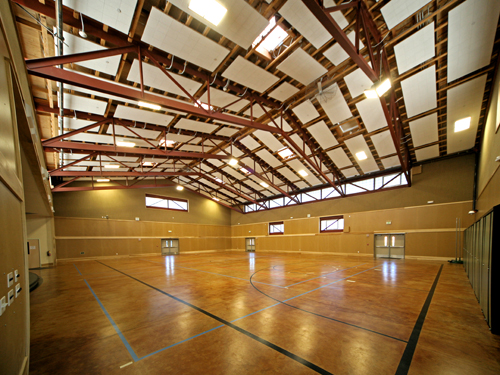
San Jose, CA Morgan Hill Unified School District and the City of San Jose Collaborate on California’s first LEED™ Certified Public Elementary School. In the spring of 2003, the Morgan Hill Unified School District (MHUSD) proposed a four million dollar $4,000,000.00 project to build a new multi-purpose building for the existing elementary school in San Jose, CA. Concurrently, the City of San Jose sought a location for a new Community Center to augment its older facilities. Both parties recognized the financial and spatial advantages of a joint-use project, and the opportunity to create a model green building for future educational and municipal projects. The project team, composed of Weston Miles Architects (WMA), Duquette Structural Engineers, Axiom Mechanical Engineers, SCE Electrical Engineers, C2G Civil Consultants, Welsh Commissioning Group, Bennington Conover LEED™ consultants, Construction Manager TBI and Morgan Hill Unified and the City of San Jose representatives, set out to achieve LEED™ certification, as well as to participate in Savings By Design through PG&E. The main design solution was achieved by the team’s decision to use Insulated Concrete Forms (ICF) as the core structure. Attractive for its impressive thermal and acoustical properties, ICF blocks are self-scaffolding units composed of two layers of foam insulation that are connected by a polypropylene (plastic) web. When stacked, the blocks create a hollow form in which concrete is then poured, resulting in the equivalent of an 8” or 10” solid poured-in-place concrete wall. The internal polypropylene web allows for easy placement of rebar by snapping rebar into place. ICF departs from a conventional concrete wall in its integration of foam insulation and concrete, a combination that substantially reduces heat transfer through the wall. By lowering the indoor climate’s fluctuation with the outdoor temperatures, the ICF walls allowed the Design Team to specify a smaller HVAC system, reducing the building’s long-term energy consumption. The ICF construction had an added benefit of providing for sound control. The building’s shared ownership required a complex program, the gymnasium, cafeteria and auditorium claim the same space and adjacent meeting rooms were to be accessed at all hours, requiring acoustical management. The ICF walls allow speakers in the auditorium to project into the audience without the resounding echoes typical of standard gymnasiums and when used as a gymnasium or cafeteria the space is quiet with the reverberation muted. The offices next to the auditorium/gymnasium are protected from noise infiltration, creating environments conducive to group meetings.
Through the use of ICF, Los Paseos Multi-Purpose Building earned 29 LEED credits, about a quarter of which directly resulted from the material’s energy-conserving properties. The building was also awarded a comparable number of points for site strategies, such as preserving open space, providing access to alternative transportation, and reducing the building’s impact on the City’s storm water system. The building’s light green cool roof contributed to maintaining cooler interior temperatures, and operable windows and fans allowed for natural breezes to flow through and cool the building. The building uses 30% less water than other buildings of its kind, with low or no water fixtures like waterless urinals. The building materials included recycled materials and those low in Volatile Organic Compounds (VOC’s). Although the Project Team understood the thermal and acoustical benefits of ICF construction, and ICF blocks are rigorously tested by the manufacturer, the project team still faced strict scrutiny from the Division of the State Architect (DSA), a department relatively unfamiliar with ICFs. DSA required the Team to provide additional structural engineering and construction review and develop a specific ICBO for the fire-rated wall assembly. The design team’s sustainable objectives also extended to construction practices, earning points in the Materials and Resources category. During construction, over 40 tons of debris was diverted from landfill. ICF blocks are ordered like Legos®, each block designed to fit in a specific location, ICF waste is virtually nonexistent and finish materials can be directly attached to the webs. Sustainability can best be summed up as using minimal resources in the construction, the interior and exterior finishes exemplify the simplicity that is central to a Green School. The Morgan Hill Unified School District has more than a LEED plaque to show for their environmentally friendly efforts. The district now saves over $10,000 per year on energy, and over $5,000 on their water bill. Six Hundred students currently attend Los Paseos Elementary School, which has now integrated workshops related to sustainability into the curriculum. Introducing environmental issues at the elementary school level is critical to the future of sustainable design and the longevity of the planet. The multi-purpose building is an active example of these values at work, and has set the standard for design in the educational community. |
||||||||||||||




Home | Our Company | Sustainable Design | Recent Projects | Awards | Careers | Contact Us Copyright ©2012 Weston Miles Architects. All rights reserved. |
 |